
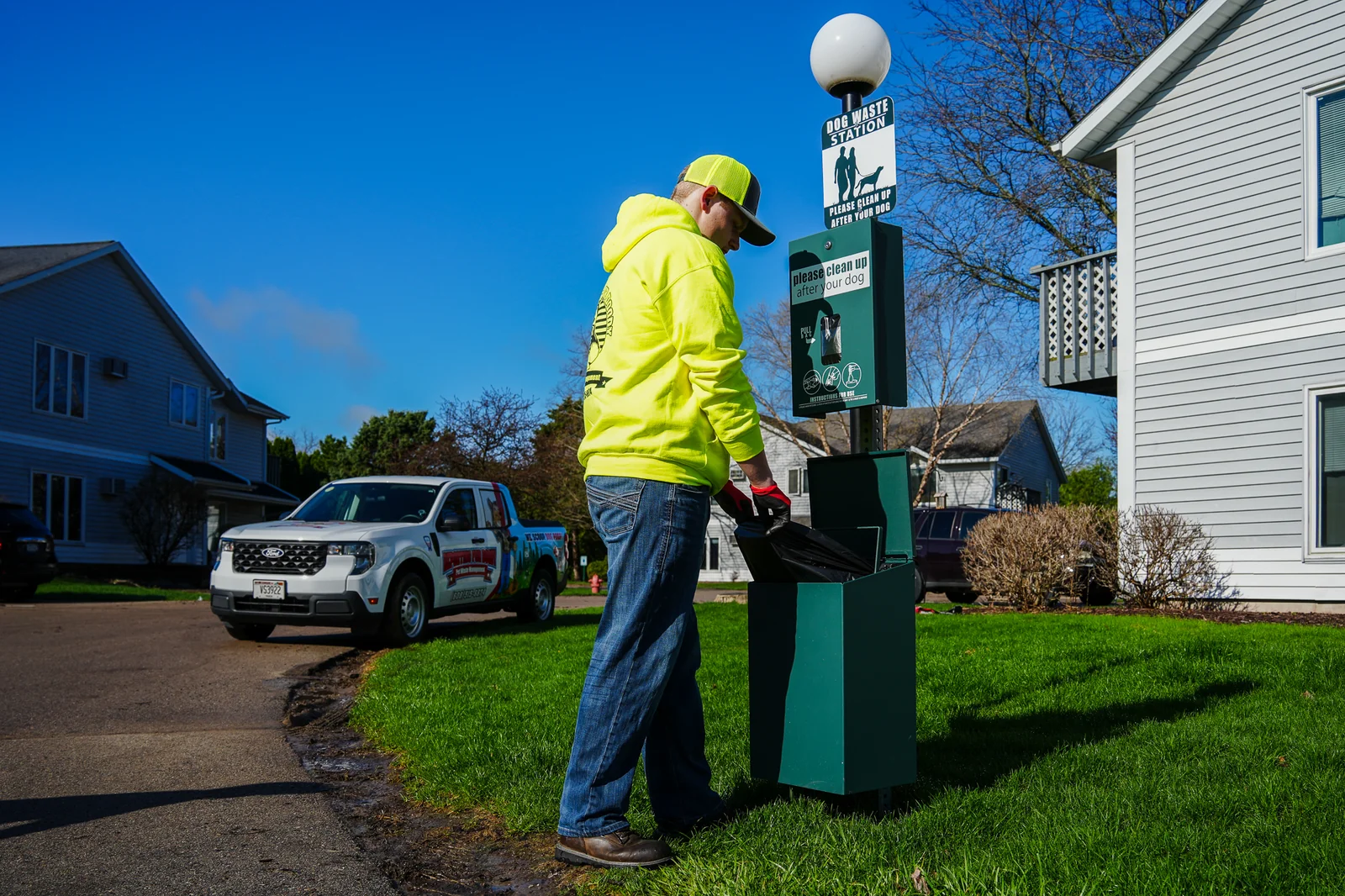
Hiring a dog waste removal company is a slightly strange transaction. You are giving a stranger a gate code, standing access to your back yard, and proximity to your dog, usually without ever meeting them. Most people book the first company whose website loads and hope it goes fine.
It usually does. But the gap between the good operators and the bad ones in this business is wide, and it shows up in exactly nine places. Here they are, along with our own answers, so you can hold us to the same standard as everyone else you are calling.
1. Are you insured and bonded?
Ask for it plainly, and ask them to say the words rather than pointing at a badge on their homepage.
This matters more than it sounds. Someone is opening your gate every week. If a gate gets left unlatched and your dog gets out, or a technician is hurt on your property, uninsured is the difference between an apology and a problem that lands on your homeowner's policy.
Ours: fully insured and bonded. Every technician is background-checked before they are handed a route.
2. Who is actually coming into my yard?
The right answer involves a name, a uniform, and a marked vehicle. The wrong answer is vague.
A lot of this industry is one person with a truck and a Craigslist ad, which is fine right up until they take a week off and nobody tells you. Ask whether they run a crew, whether technicians are employees or subcontractors, and whether you will see the same person most weeks.
There is also a franchise question worth asking, because Madison has national brands with local pages. Ask who owns the local operation and whether it is currently staffed. A national domain with a city page on it is not the same thing as a company with trucks in Dane County, and at least one national brand's Madison operation has been listed as closed while its city page stayed up.
Ours: a small crew of employees, background-checked, in uniform, in marked trucks. Madison-area dispatch, not a national call centre routing your address to whoever is nearest. You can meet the crew here.
3. Do you haul the waste away, or leave it in my bin?
This one quietly separates services that are worth paying for from services that just move the problem ten feet.
Plenty of companies bag the waste and drop it in your own garbage bin. In July, that means your bin becomes the thing you now have to deal with. Ask specifically: does it leave the property?
Ours: everything leaves with us, every visit, and goes to eco-friendly off-site disposal. It is included in the price, not an add-on.
4. Am I locked into a contract?
Ask about minimum terms, cancellation notice periods, and early-termination fees. Ask whether a promotional rate converts to a higher one, and when.
Some perfectly reputable companies do require a minimum term, and that is a fair trade for a discount. What is not fair is finding out about it after you have signed.
Ours: routine weekly and bi-weekly service has no long-term contract. Cancel any time. If we ever run a promotion with a minimum term attached, that minimum is stated in the offer itself.
5. What happens if you miss a spot?
Everybody misses one eventually. Long grass, deep shade, a dog with creative habits. The question is what happens next.
You want a stated policy, not goodwill. "Call us and we'll see" is not a policy.
Ours: the Doody-Free Guarantee. If we miss a spot, tell us and we come back and re-clean it. No argument, no charge.
6. What is my actual first-month total?
Not the per-visit rate. The total, including anything that only appears once.
Almost every company in this business charges some form of initial cleanup fee for a yard with a backlog, and almost none of them lead with it. Ask for the number, ask what triggers it, and ask whether it is capped.
Ours: $16 per visit weekly for one dog on a quarter acre, plus a one-time initial cleanup of $25 to $80 on the first invoice only: $1 per minute past 25 minutes, hard-capped at $80. We wrote out the complete pricing, including a worked first-month example.
7. Do you actually service my street?
"The Madison area" can mean anything. Some companies quote you happily, then discover on the day that you are outside the route.
Ask for your specific city, or better, your neighbourhood.
Ours: 29 cities across South Central Wisconsin, each with its own page listing the zip codes we cover. Find yours here before you spend time on a quote.
8. What happens in rain, snow, and a Wisconsin deep freeze?
This is the Madison-specific question, and it is the one most likely to expose a company that has not been doing this locally for long.
Ask: do you service in snow? What happens when the ground is frozen? Do you skip visits in bad weather, and am I charged for a skipped visit? What about a yard where waste has been buried under snow for six weeks?
The honest answer from anyone operating here is that deep snow cover genuinely limits what is retrievable, and that spring thaw is a real event that needs a plan. Be suspicious of anyone who claims winter changes nothing. A fresh six inches over a yard means some of what is under there is not coming up until it melts, and a company that pretends otherwise is either not working in Wisconsin or not telling you the truth.
Ours: we run year-round, through rain, snow and normal Wisconsin winters. In severe weather (lightning, ice storms, genuinely dangerous conditions), we reschedule to the nearest available day and tell you in advance. You are never charged for a visit we could not complete.
9. How do I cancel or pause?
Ask before you need to. Vacation holds, seasonal pauses, and cancellation should all be things you can do without a phone call and a retention pitch.
Worth asking specifically: can you pause for a month without losing your slot on the route? Snowbirds and anyone who travels in summer run into this, and the answer varies a lot between companies.
Ours: email, call, or message us. No notice period, no cancellation fee, no script.
Three red flags
Separate from the nine questions, three things should make you slow down:
A quote with no initial cleanup fee mentioned anywhere. Either they do not charge one (worth confirming in writing) or it is going to appear on your first invoice as a surprise. This is the single most common complaint in this industry and it is entirely a disclosure problem.
A price that is dramatically under everyone else. Weekly rates in Madison cluster fairly tightly for a reason: it is a real route with real fuel, insurance, disposal, and labour behind it. A number well under the pack usually means something is missing from it: most often disposal, which means the waste is going in your bin.
No physical address and no named owner. Lead-generation sites are common in this business. They collect your details and resell them to several providers, which is why some people fill in one form and get four calls. If you cannot tell who you are actually hiring, you are probably not hiring anyone yet.
The pattern underneath these questions
Every one of the nine is really the same question: is this a business, or is this a guy?
Nothing wrong with a guy. But a business carries insurance, screens the people it sends to your address, has a written guarantee, publishes its prices, and is still answering the phone in February. That is what you are actually buying at $16 a visit, and it is why the cheapest quote is not automatically the best one.
If you want to see how we stack up against doing it yourself and against the other options in town, we laid it out here. Our 299 Google reviews are the unfiltered version, and if you would rather read the answers to a longer list of questions, our FAQ has 19 of them.
Ready when you are
Ask us all nine. We would rather answer them now than have you wondering in month three.
Get your free quote: about two minutes, no credit card, no sales visit.